Black water
Black Water (Joyce Carol Oates Edition)Black water is the novel’s most immediate image of danger made physical: the hidden water into which the Toyota plunges becomes a confined, rising threat to Kelly Kelleher, surrounding her with darkness, wreckage, and the gradual loss of breathable air. It is at once a feature of the marshland, the force that traps her, and the recurring medium through which the narrative tests the boundary between present terror, memory, and imagined rescue.
Marshland and Sudden Inundation
The water is foreshadowed by an atmosphere of dampness and decay. Around the road lies a powerful brackish-marsh odor of black earth and black water; the Atlantic’s fresh, stinging smell seems remote, and the surf cannot be heard. In its place are nocturnal insects and wind moving through stunted, vine-laden trees. The setting is not open water but an inland landscape whose darkness conceals what lies at the road’s edge.
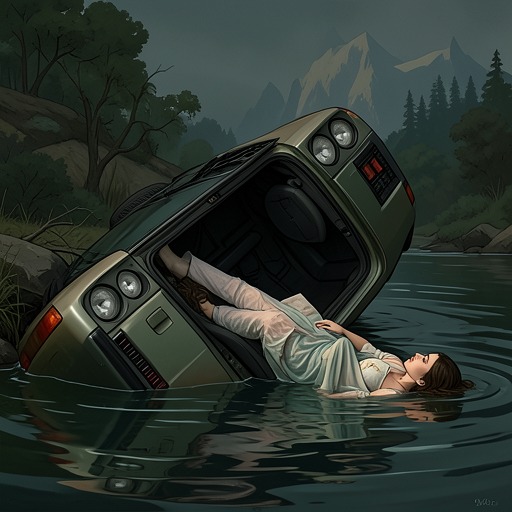
At about 8:15 p.m., while The Senator and Kelly Kelleher hurry toward the 8:20 ferry from Brockden's Landing, the rented Toyota plunges into an unanticipated body of water at the apex of a hairpin curve. Neither occupant had known it might be there, and no witness sees the crash. The narrative itself cannot confidently name the water as creek, stream, or river, preserving the disorientation of a vehicle entering a landscape whose geography has not been understood.
The collision converts that hidden possibility into an engulfing fact. Water surges over the hood and cracked windshield, churning as though alive and angry. In the extended account of the crash, the guardrail gives way, rushes strike the windows, glass fractures into a spiderweb pattern, and the Toyota sinks instead of floating. The passenger door buckles inward; the black water foams over the roof. The vehicle, previously experienced as an obedient plaything during the drive, becomes a damaged enclosure with no simple way out.
A Confined Body and a Rising Level
For Kelly, the submerged car makes survival a problem measured in air and time. She cannot tell how far beneath the surface the vehicle is; it might be only inches. A pragmatic part of her mind reasons that trapped air remains inside, but that the car cannot stay sealed: water must seep through its many holes, fissures, and windshield cracks, and the level must rise. She knows reports of people surviving for hours in submerged cars and tries to make rescue depend on patience rather than panic. Yet the same calculation supplies the threat: water will eventually reach her mouth, throat, and lungs.
The blackness does not make the danger abstract. Kelly coughs and chokes, and black muck rises into her mouth. Later, the water around her smells of sewage, gasoline, oil, and her own urine. What initially appears to her as rivulets running across her face feels like the touch of leeches; she has to recognize that it is water. These bodily details turn the car into a place where perception itself is under pressure: contamination, cold, darkness, and the struggle to breathe shape what she can know and do.
The distinction between the water’s silent advance and its undeniable consequence is especially stark. Kelly cannot see or hear it trickling through the car, but she understands that it is rising. The scene’s patient increments—leaks, retained air, a shrinking bubble—make the threat both nearly imperceptible and inescapable. Survival depends on an air pocket that is real but diminishing, and on Kelly’s ability to preserve it while the car remains submerged.
Rescue, Abandonment, and the Limits of Faith
Kelly hears The Senator somewhere above the surface and believes he is moving cautiously in the shallows, diving and swimming to save her. Unable to reach him, she tries to guide him with her call that she is there. The black water rises toward her lungs while she continues to place faith in rescue. Her understanding of the accident includes the terrible fact that he kicked her in his panic as he tried to escape; she also interprets his action as blind terror, not a deliberate decision to abandon her. That interpretation sustains her trust even as the water makes its cost immediate.
The promise she remembers—that he would come to her—competes with her practical knowledge that the car will fill. The scene holds those opposed forms of understanding together: she knows what the water will do, yet believes he will reach her. Her hope is not proof of safety. Instead, the gap between expectation and bodily circumstance makes the rising water an image of how little control Kelly has over either rescue or the time remaining to her.
Death and Narrative Recurrence
The image reaches its most devastating form when the black water fills Kelly’s lungs and she dies. The account does not leave that moment as a stable endpoint. Around the assertion of death, the narrative turns to Kelly among friends watching tennis, fingering wild rose petals and thorns, and later returns to drowning. Near the conclusion, the black water again fills her lungs and she dies; then the narration pivots at the last possible moment to her coughing, choking attempt to lift herself toward a remaining bubble of air. She grips what she can no longer quite identify as the steering wheel, treating it as a device that might save her.
That reversal carries the reader from apparent death to a fleeting image of survival: Kelly imagines herself embracing Buffy St. John, calling her a sister, and apologizing for having deliberately shut her out for two or three years. The narrative then asks whether the accident has happened at all, returning to the Toyota speeding along the road toward the swamp. Black water therefore marks not only a physical fate but the unstable seam between drowning, anticipated death, and imagined life beyond the car. Its recurrence refuses a clean separation between what Kelly suffers, what she fears, and what the narrative briefly allows her to survive.
Thematic Significance
Black water concentrates the novel’s attention on the body as both a site of exposure and the remaining instrument of action. On the beach, Kelly experiences desire through a male counterpart’s grasp, kiss, and urgency, and feels anxiety that having made him want her means she cannot refuse him. In the car, that already constrained bodily situation becomes literal entrapment: she cannot open the buckled door or move freely, and survival is reduced to breath, touch, and the effort to keep her head above water. Her bargaining to sacrifice one or even both legs for rescue shows how far she is willing to go to remain alive; she promises to sign a release and not sue.
The contrast between the scene’s earlier exhilaration and its aftermath sharpens the water’s significance. A moonlit drive and a hard kiss give way, within minutes, to a vehicle sinking beneath black water. The water does not simply interrupt the romantic journey; it exposes the difference between desire and consent, between a companion’s promise and dependable rescue, and between the appearance of agency and the constraints imposed on Kelly’s body. As the narrative returns to the water at the point of apparent death and then opens briefly onto another possibility, blackness becomes the novel’s central image of danger and uncertainty—an element that closes around Kelly without ever fully settling what she has lived through.